High Level Function 3.1 Provide Traffic Control
 Diagrams   Definition   
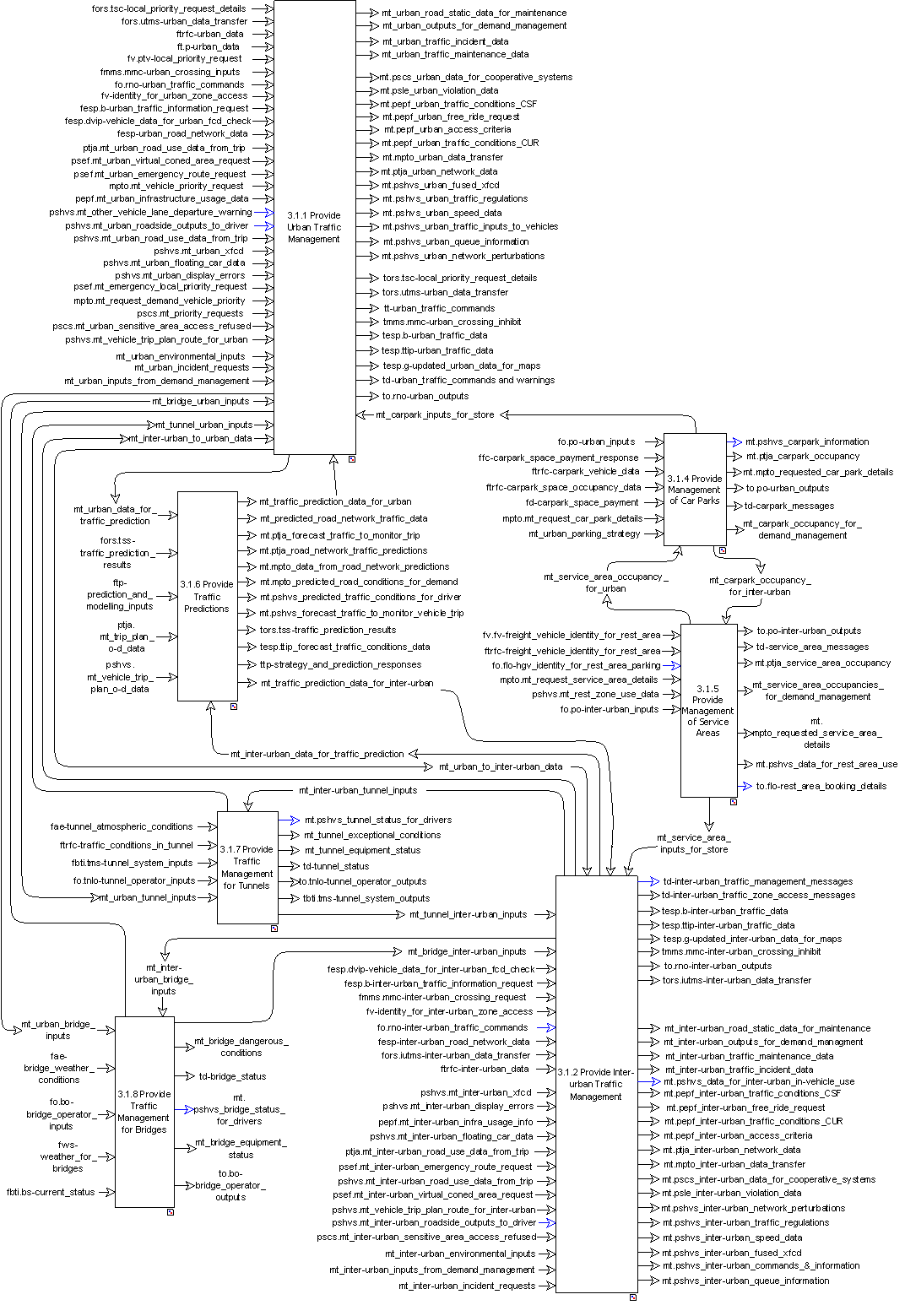
DFD 3.1 Provide Traffic Control
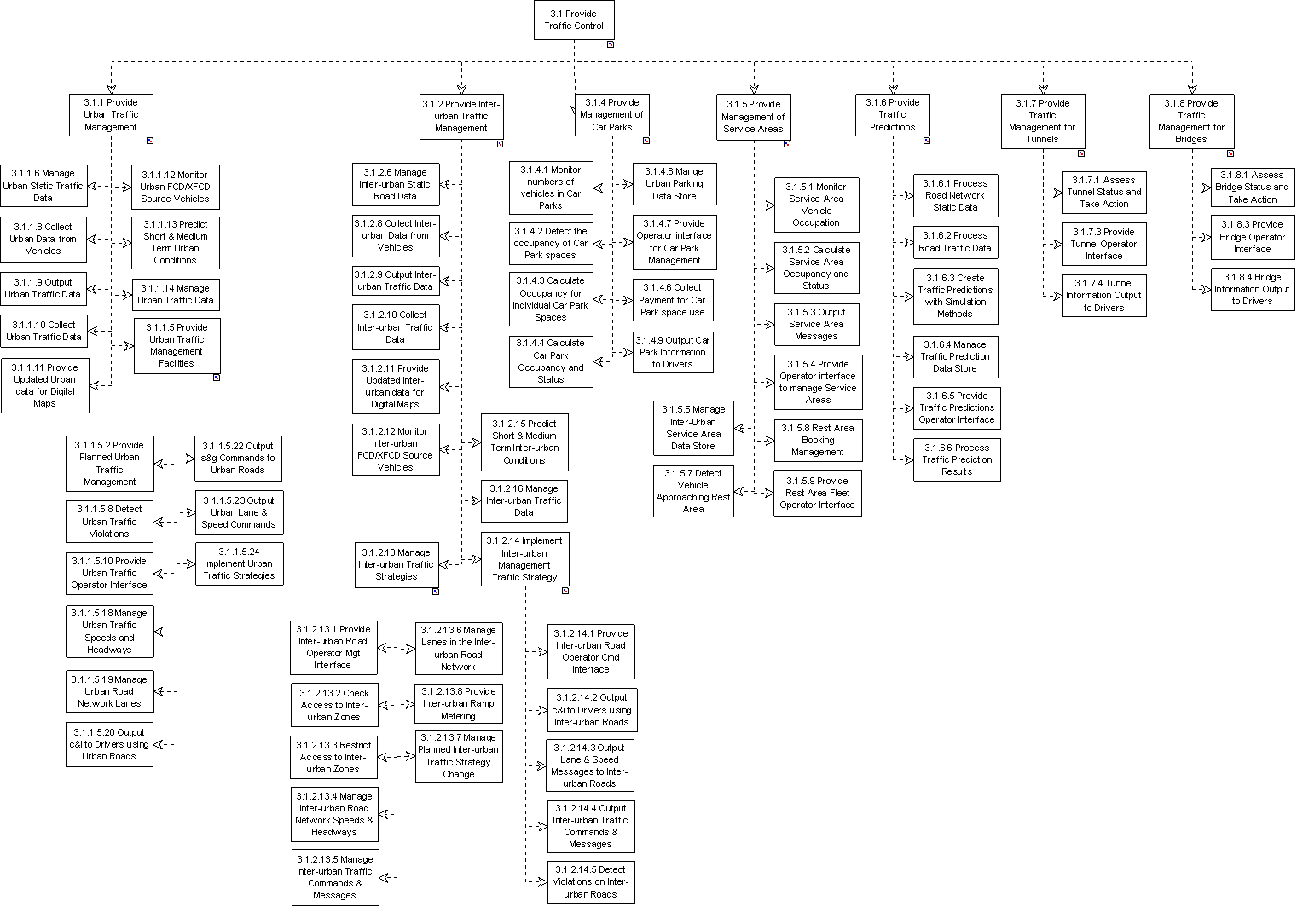
Functional tree 3.1
DFD 3.1 Provide Traffic Control

This is a DFD diagram which provides a description of the function in the ITS environment

Functional tree 3.1

This is a DFD diagram which provides a description of the function in the ITS environment

Overview

This High-level Function shall provide facilities for the management of traffic using the road network.  It shall include functionality for managing both the urban and inter-urban parts of the network.  Facilities shall be provided that enable data to be collected about the use of the road network and to provide priority for selected vehicles.

Diagrams

The Diagram(s) is(are) the Diagram(s) where you can find the function
  • The first diagram, if exists, is a DFD diagram which provides the context of the function
  • The second Diagram, if exists, is a Functional Tree which provides a hierarchical description of the function into subfunctions
  • DFD 3. Manage Traffic
  • Functional tree 3.1
  • Functional Tree of Area 3
  • Parent

    Component lower level functions

    This Functional Area contains High-level Functions covering the management of traffic in the "urban" and "inter-urban" parts of the road network, plus the management of traffic using bridges and tunnels. In this context, the definition of "urban" and "inter-urban" road networks are as follows.

    (a) "urban" - these are road networks that have lots of junctions, some controlled, some not. The type of traffic management that is provided is one that enables rights of way at some or all of the junctions to be managed. These rights of way may be for any combination of vehicles in general, particular types of vehicle (e.g. Public Transport), bicycles and/or pedestrians. In most cases the junctions will be close enough to enable their operation to be co-ordinated for the improvement of traffic flow. Other management options such as lane and speed management may also be used in the parts of the network between the junctions. The main emphasis of traffic management strategies will usually be on making the most efficient use of road network. Other facilities such as priority for Public Transport and Emergency Services' vehicles, pedestrians and cyclists, plus the management of car park use may also be included in any System implementation. When included in particular Systems. the use of enforcement facilities will be for compliance with traffic regulations including speeding.

    (b) "inter-urban" - these are road networks that have few junctions. What junctions there are enable traffic to enter and leave the network and are usually "grade separated", i.e. they have flyovers and underpasses. None of the junctions are controlled in the sense that traffic within the network can be stopped from moving through the junction, as in those that are part of an "urban" road network. Management of traffic is confined to regulating vehicle speeds (higher than in the "urban" network) and lane use, through various types of signs, and restricting access of vehicles to the network - sometimes called "ramp metering". Any special facilities for Particular types of vehicle (e.g. Public Transport and Emergency Services) will be provided through lane management, or the control of access ramps. It will be unusual for facilities to be provided for pedestrians and cyclists as they are normally prohibited from using this type of road network due to the higher average speed of the other vehicles. When included in a particular System implementation, enforcement facilities will cover speed conformity and sometimes lane discipline. This type of network usually provides links from one urban area to another and in so doing may pass through urban areas. However the method of traffic management does not change for the parts of the inter-urban network that are within urban areas.

    The management of "rural" road networks has not been covered by a separate set of Functions. This is because the management of traffic in this type of network can be provided by using the functionality for the "urban" road network described in (a) above. In this case there will be few if any controlled junctions, long distances between such junction. Often the roads will be narrow, with lots of bends and limited use of mutli-lane carriageways. This means that in general average speeds will be lower that those on "inter-urban" road networks, but higher than those on "urban" road networks. The degree of co-ordination between successive junctions may be slight or non-existent due to the large distances that will separate them. There will be no need for speed management other than by static signs and no opportunity for special measures for particular types of vehicle, e.g. Public Transport and Emergency Services. Thus the main management focus of System implementation for "rural" road networks will be on traffic information and diversions. The use of incident management may be quite important because the options for detection by other vehicle users will be limited.

    The management of bridges and tunnels will be designed to detect abnormal conditions (e.g. weather condition on bridges, and fire or pollution in tunnels). The occurrence and impact of these conditions will be used by the other two lower level Functions to provide driver information and implement diversions. It is assumed that bridges and tunnels can be part of both "urban" and "inter-urban" road networks, so links are provided to both of these lower level Functions. The provision of ventilation, lighting and other such services within tunnels is assumed to be covered by other systems, that are outside of the Framework Architecture.

    The division of functionality into the three High-level Functions shown in the DFD has been used because the way in which each of these three parts of the road network is managed will be slightly different. Each of these High-level Functions is designed to work on its own, but will link with the others if they are present and co-ordination of their traffic management activities is needed. These links will enable the provision of co-ordination between urban and inter-urban traffic management strategies and the sharing of data.

    Links to neighbouring urban traffic management systems and regional inter-urban traffic management centres are provided through the Data Flows to and from the Road Related Systems terminator. Although these Data Flows only link to one terminator, it is possible for the data to be sent to, or received from, a number of different Systems. Thus the single terminator can represent one or more other Road Related Systems.

    Input logical dataflows

    Output logical dataflows

    User needs

    Number

    Description