High Level Function 3.1.2.14 Implement Inter-urban Management Traffic Strategy
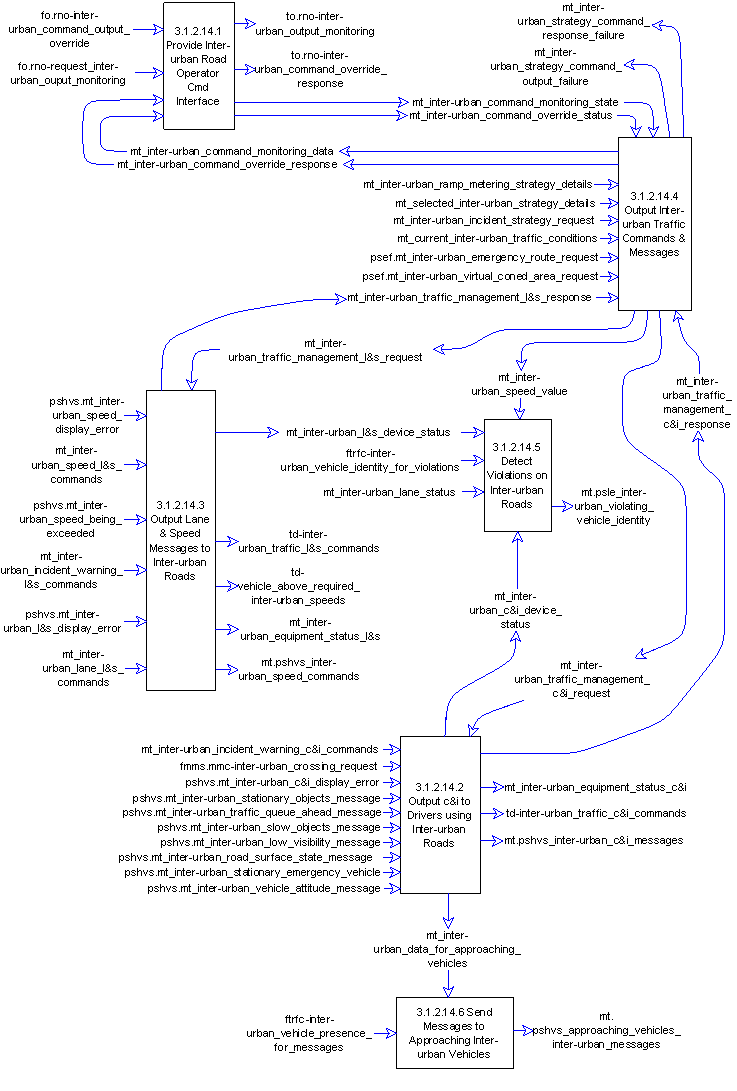
 Diagram   Definition   
DFD 3.1.2.14 Implement Inter-urban Management Traffic Strategy

DFD 3.1.2.14 Implement Inter-urban Management Traffic Strategy

This is a DFD diagram which provides a description of the function in the ITS environment

Overview

This High-level Function shall be responsible for the actual output of messages and that status of signs that can be seen by Drivers using all or part(s) of the inter-urban road network.  If shall be able to use these messages and signs to manage the use if the inter-urban road network by Vehicles.  This shall include restricting the use of lanee, settting speed limits, assigning particular types of Vehicles to particular lanes and other measures that will help to optimise and improve the efficiency with which the inter-urban road network is used, as well as reducing the impact of Vehicles on the environment.  The Function shall enable the currnent strategies to be temporarily overridden in order that Emergency Vehicles can be given green waves, or part(s) of the inter-urban road network can be "coned" off to enable the Emergency Services to respond to incidents.    If a Vehicle violates one or more of any mandatory messages and/or sign states, it whall be possible for its details to be sent to the functionality that will forward them to the Law Enforcement Agency.  It shall also be possible for the Road Network Operator to have access to the functionality to both monitor what messages and sign states are being output and to override some or all of those outputs if necessary.

Diagrams

The Diagram(s) is(are) the Diagram(s) where you can find the function
  • The first diagram, if exists, is a DFD diagram which provides the context of the function
  • The second Diagram, if exists, is a Functional Tree which provides a hierarchical description of the function into subfunctions
  • DFD 3.1.2 Provide Inter-urban Traffic Management
  • Functional tree 3.1
  • Parent

    Component lower level functions

    Input logical dataflows

    Output logical dataflows

    User needs

    Number

    Description